Concrete Work: Sidewalks, Driveways & Patios
Sidewalks, driveways and slab patios poured right: compacted sub-base, proper grade, control joints placed to prevent cracking, and a broom or brushed finish that holds up season after season.
Request a free estimate View Our Full Gallery →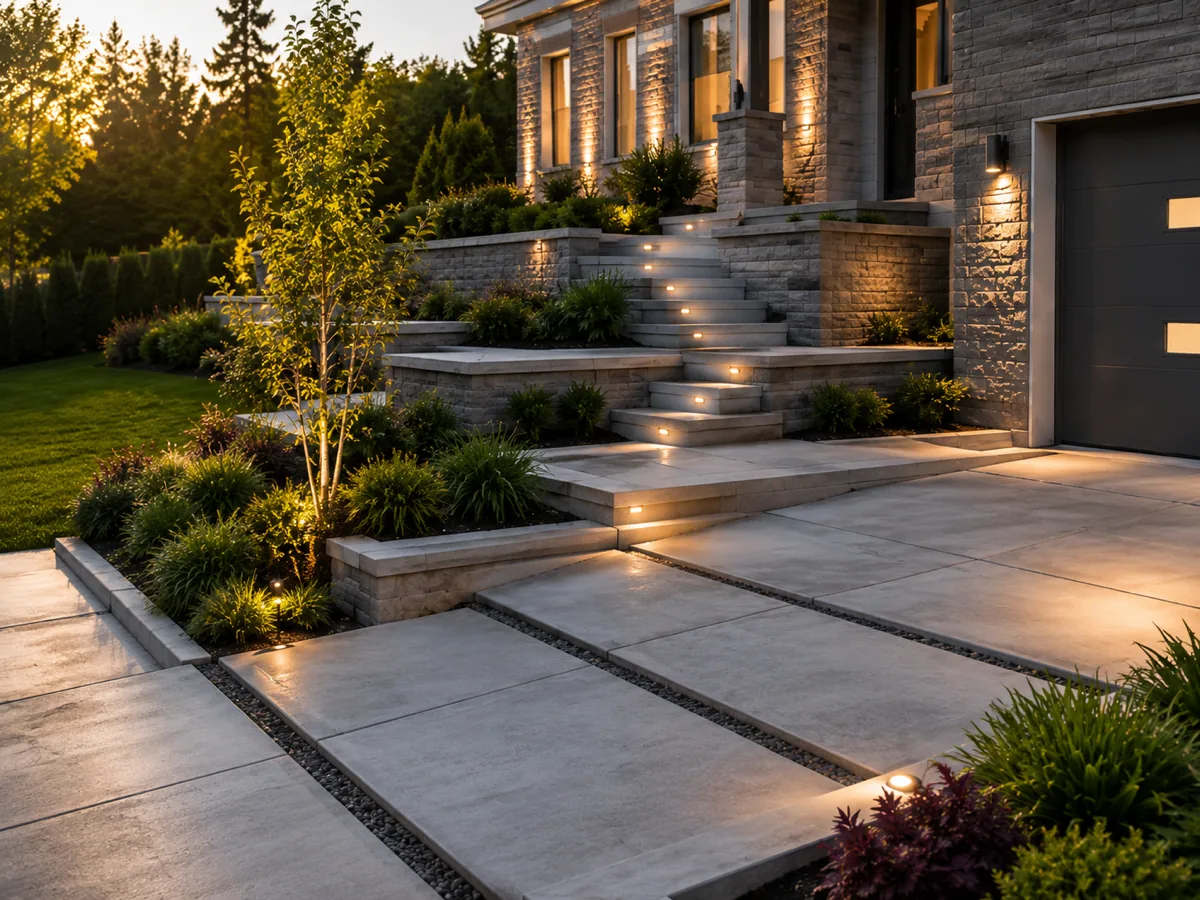
- Concrete sidewalks & walkways
- Driveways: broom finish, exposed aggregate or brushed
- Slab patios & outdoor floors
- Steps and stoops
- Proper sub-base, compaction & control joints
- Curing and sealing on request
- Cracked, heaved or spalling old concrete
- Uneven driveway that pools water or creates trip hazards
- No proper outdoor floor surface for patio or entry
- Driveway that's failed two seasons after the last pour
Four steps from the first visit to the finished work.
- 01
Consult
We visit your property, listen to how you want to use the space and take measurements.
- 02
Design
You get a clear plan and a written quote covering materials, layout, drainage, timing and price.
- 03
Build
Our in-house crew prepares the site, installs hardscape and softscape, and cleans up daily.
- 04
Maintain
If you want, we come back each season for aeration, fresh mulch and irrigation tuning to keep it looking new.
Driveway, sidewalk and patio concrete pricing around Lake Norman
Plain broom-finished concrete runs roughly $8 to $14 per square foot installed for a standard four-inch residential slab. A typical two-car driveway lands between $6,500 and $12,000 depending on thickness, access and how much tear-out the old surface needs. Removing and hauling an existing slab usually adds $2 to $4 per square foot on its own.
Decorative finishes cost more: a broom finish is the baseline, exposed aggregate and stamped work sit above it, and integral colour adds to any of them. The honest comparison for a patio is against pavers, which cost more per square foot but do not crack. For a driveway, concrete is usually the right call. For a patio in our clay, it often is not, and we will say so.
Thickness, mix, rebar and the joints that decide where it cracks
Concrete cracks as it cures and as the ground moves beneath it, and that is normal. The craft is in controlling where. Control joints are cut or tooled at regular spacing, roughly two to three times the slab thickness in feet, so the slab cracks in a straight line at the bottom of a groove instead of randomly across the middle.
- Thickness. Four inches for walks and patios. Five to six where vehicles run, and six under anything heavier than a car. Saving an inch on a driveway is the cheapest way to guarantee a repair.
- Mix strength. Exterior flatwork in North Carolina should be air-entrained, which gives the water somewhere to go when it freezes. Interior-grade mix outdoors spalls after a few winters.
- Reinforcement. Rebar or mesh does not stop cracking; it holds the two sides together and level when a crack does happen, which is the difference between a hairline and a trip hazard.
- The base. Same as any hardscape: compacted aggregate over a prepared subgrade. A slab poured on soft clay will settle no matter what is in the mix.
Expansion joints go anywhere the slab meets the house, a step, or another slab, so the two can move independently. A driveway poured tight against a foundation transfers every bit of its movement into the house.
The first week, and the winter after it
Concrete gains most of its strength in the first seven days and keeps gaining for a month. Keep foot traffic off for 24 to 48 hours and vehicles off for seven days minimum, longer in cold weather. A slab driven on too early can look fine and still have lost strength it never gets back.
The two things that ruin new concrete in this area are pouring in the wrong conditions and de-icing salt. We do not pour when a hard freeze is coming within 24 hours, and we do not pour onto frozen ground. And no salt on concrete in its first winter, because rock salt drives the freeze-thaw cycle straight into a young slab and produces the flaking surface you see on so many driveways. Sand gives traction and does no damage.
Concrete, pavers or gravel: how they compare
Concrete is the best value for driveways, sidewalks, garage aprons and slabs under sheds or HVAC units. It is fast, it takes weight, and per square foot nothing beats it. Its weakness is that a crack or a stain is permanent, and a repair never quite matches.
Pavers cost more and win where appearance matters and where the ground moves (patios, walkways, pool surrounds) because they flex instead of cracking and a damaged unit lifts out. Gravel is cheapest and fine for a long rural drive or a utility area, and wrong anywhere it will be walked in dress shoes. We install all three and have no reason to push you toward the expensive one.
Need a driveway or slab that holds up? Let's walk your property.
We'll walk the property, ask how you want to use it, and follow up with a written quote that lays out scope, materials and price. We won't push extras you didn't ask for.
Get Your Free Concrete Estimate
Tell us about your project and a local LAP Landscaping crew member replies quickly with a clear plan and an honest price, with no pressure and no obligation.
Form not loading? Call 704-327-5663.
Explore more services