Landscape Lighting | Troutman & Lake Norman NC | LAP Landscaping
Bilingual service · Licensed & insured 704-327-5663 [email protected] Privacy PolicySMS Terms🌎Hablamos Español · We serve clients in English & Spanish
← Back to home Service · Lighting

Landscape Lighting Design & Installation

The right lighting changes how you use your yard at night. We design path, deck and accent lighting that flatters the architecture, makes walkways safer and stretches outdoor evenings into all four seasons — all on energy-efficient LED systems with smart timers.

Request a free estimate
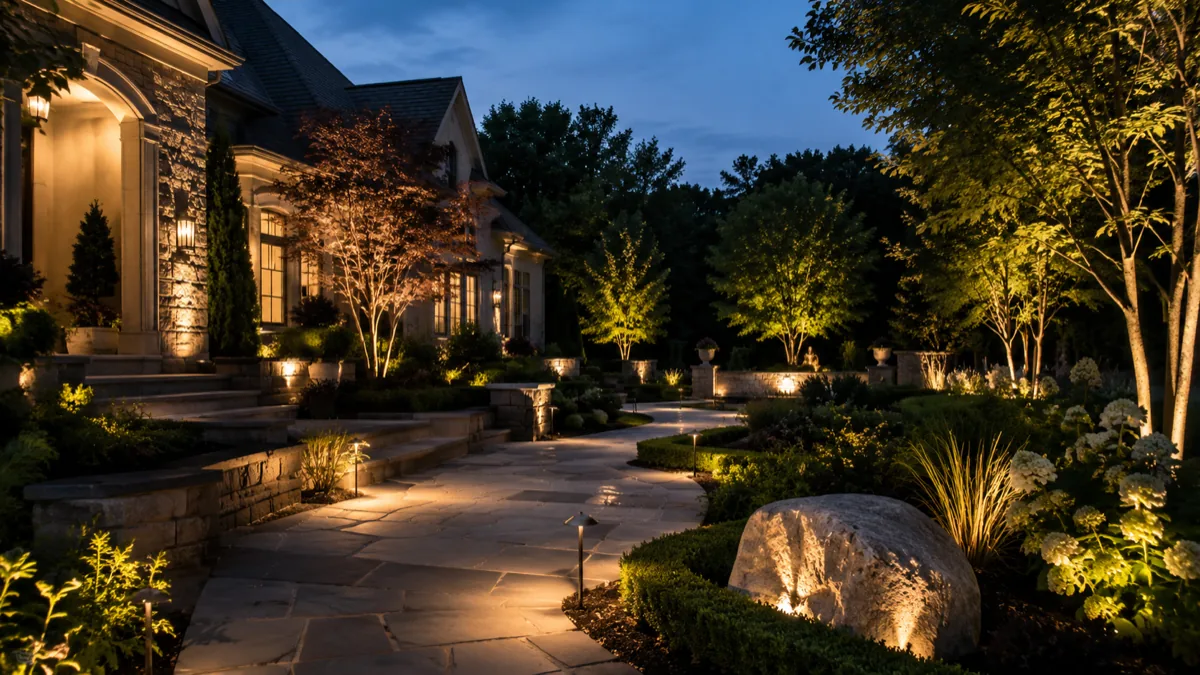
Premium landscape lighting on a stone walkway with uplit trees and warm path lights at dusk
What's included
  • Path & walkway lighting
  • Deck, step & patio lighting
  • Up-lighting & tree accents
  • Façade & architectural accent lighting
  • Low-voltage LED transformers & smart timers
  • Buried wiring & clean fixture placement
Problems we solve
  • Yard goes dark and unused at night
  • No curb appeal after sunset
  • Harsh, glaring or mismatched older fixtures
  • Unsafe walkways, steps or driveways
Our process

A simple, four-step path from idea to finished yard.

  1. 01

    Consult

    We visit your property, listen to how you want to use the space and take measurements.

  2. 02

    Design

    You get a clear plan and a written quote — materials, layout, drainage, timing, and price.

  3. 03

    Build

    Our in-house crew prepares the site, installs hardscape and softscape, and cleans up daily.

  4. 04

    Maintain

    Optional seasonal care — aeration, mulch refresh, irrigation tuning — keeps it looking new.

What it costs

What outdoor lighting costs, and why fixture count is the wrong question

A modest front-of-house design — a few uplights on the facade, path lights along the walk, a transformer and wiring — generally runs $2,200 to $4,500 installed. Larger designs that wrap a back yard, a patio and specimen trees run $5,000 to $12,000. The number that moves the price is not how many fixtures; it is how much trenching and how large a transformer the layout needs.

Cheap kits from a big-box store are the false economy in this category. Thin-gauge wire, plastic fixtures and an undersized transformer give you a system that looks acceptable for one season and then browns out at the far end of the run as fixtures corrode. Cast brass and copper fixtures cost more up front and are still working in ten years, which on a lighting system is the entire point.

How it works

Low voltage, wire gauge and the reason far lights go dim

Residential landscape lighting runs at 12 volts through a transformer, which is why it is safe to work around and why cable can be buried shallow. The failure everyone recognises is the last fixture on a long run glowing weaker than the first. That is voltage drop, and it is a design problem, not a bulb problem.

The fix is choosing wire gauge for the length and load of each run rather than using one spool for everything, splitting long runs into multiple home runs back to the transformer, and sizing the transformer with headroom so it is not running at its limit on day one. We use direct-burial cable with waterproof connections; the twist-on connectors packed with cheap kits fail within a couple of Carolina summers.

LED throughout, so a system that once drew several hundred watts now draws a fraction of it, and lamps last years rather than seasons.

Design

Lighting the house and the trees, not the neighbours’ windows

Good landscape lighting is mostly restraint. The aim is a few well-placed pools of light and shadow, not an evenly lit yard. Uplighting a stone facade or a mature oak gives depth; a runway of path lights every four feet gives an airport. We generally use fewer path lights than people expect and place them to mark changes in level and direction, where they actually prevent a fall.

Fixtures are aimed and shielded so the source is hidden and you see the lit surface instead of the bulb. Glare into a window, yours or a neighbour’s, is the most common complaint about a system installed without a night visit. We aim everything after dark, because a fixture set at noon is a guess.

Warm colour temperature, around 2700K, on planting and stonework. Cooler light makes brick and mulch look grey and makes a house look like a car park.

Install & care

Two days on site, then almost nothing

Most residential systems install in one to two days. Cable is trenched shallow along bed lines rather than across open lawn where an aerator will find it, the transformer mounts near an exterior outlet, and the final aiming happens on a return visit after dark with you there to say what you want brighter.

Maintenance is minimal and worth doing: keep lenses clear of mulch and mud, trim growth that has swallowed a fixture, and check aiming each spring after the ground has heaved through winter. We put the system on a photocell or timer so it runs dusk to a set hour rather than all night, which cuts run time and makes lamps last longer.

Free estimate

Light the yard you'll actually use after sunset.

No pressure, no upsell. We'll walk the property, ask about how you want to use it, and follow up with a written quote that lays out scope, materials and price.

Get Your Free Landscape Lighting Estimate

Tell us about your project and a local LAP Landscaping crew member replies quickly with a clear plan and honest price. No pressure, no obligation.

Form not loading? Call 704-327-5663.

Or call 704-327-5663