
Drainage & Final Grading Solutions That Actually Work
Standing water destroys lawns, hardscape and basements. We design drainage (French drains, surface drains, dry creeks, regraded yards) that moves water away from your house and stays out of sight once installed.
Request a free estimate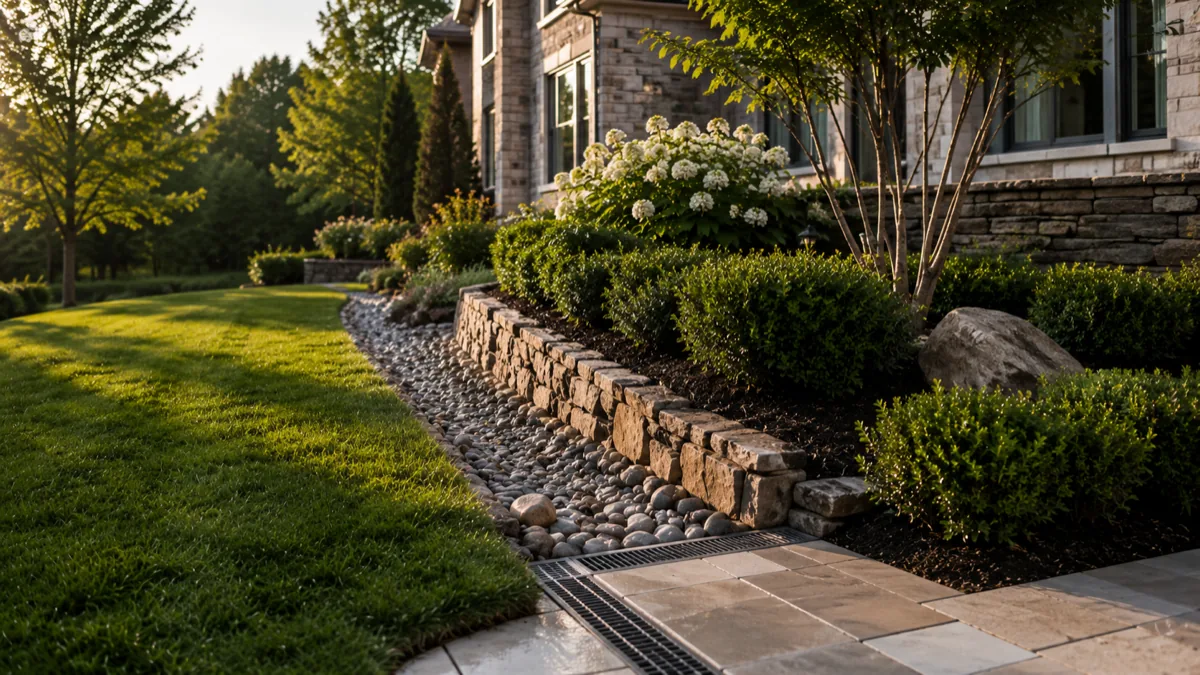
- French drains & subsurface drainage
- Surface drains & channel drains
- Final grading to slope water away from the home
- Dry creek beds & erosion control
- Downspout extensions & pop-up emitters
- Sod or seed restoration after work is done
- Standing water and soggy spots in the yard
- Water seeping into the basement or crawl space
- Erosion after every storm
- Downspouts dumping water against the foundation
Four steps from the first visit to the finished work.
- 01
Consult
We visit your property, listen to how you want to use the space and take measurements.
- 02
Design
You get a clear plan and a written quote covering materials, layout, drainage, timing and price.
- 03
Build
Our in-house crew prepares the site, installs hardscape and softscape, and cleans up daily.
- 04
Maintain
If you want, we come back each season for aeration, fresh mulch and irrigation tuning to keep it looking new.
Standing water here is a clay problem, not a rain problem
Piedmont red clay drains at a fraction of the rate sandy soil does. A rain that would soak away in an hour somewhere else sits on the surface here, and on a graded subdivision lot where the topsoil was scraped off during construction, it sits even longer. That is why the same storm floods one yard on the street and not the neighbour’s.
Most of what we get called about is one of four things: water coming off a roof and staying at the foundation, a low spot in the middle of a lawn that never dries, water arriving from a neighbouring property that sits higher, or a crawlspace that smells damp in August. Each has a different fix, and the cheapest one is almost never the right one if the water is arriving from somewhere you did not look.
We walk the property during or right after a rain when we can. Fifteen minutes watching where water actually goes beats an hour of guessing at a dry yard.
French drains, surface drains, dry wells and regrading
- French drain. A gravel trench with perforated pipe wrapped in fabric, set below the wet zone and pitched to daylight. For a saturated area or a wall that needs relief behind it. Runs $25 to $55 per linear foot depending on depth and what it has to cross.
- Surface drains and catch basins. For water that is already on top and needs collecting: a low spot, a patio edge, the bottom of a driveway. Cheaper than a French drain and the right answer more often than people expect.
- Downspout extensions. The least glamorous item on this list and frequently the whole fix. A roof puts an enormous volume of water at your foundation; moving it ten feet away solves a surprising number of wet-basement calls for a few hundred dollars.
- Dry well. A buried reservoir that holds a surge and lets it soak away slowly. Useful when there is nowhere lower to send the water, which on a flat lot is often the case.
- Regrading. Reshaping the ground so water leaves on its own. The most durable fix when the land allows it, because there is no pipe to clog and nothing to maintain.
Whatever goes in has to end somewhere legal and sensible. Discharging onto a neighbour’s property creates a dispute and sometimes a liability, and a pipe that dead-ends into clay is just a buried bucket. We identify the outlet before we price the trench.
The slope that should exist around every house
The rule is simple and widely ignored: the ground should fall about six inches over the first ten feet away from the foundation. On a lot where mulch has been topped up year after year, or where settling has pulled the soil back toward the wall, that slope is often gone or reversed. Restoring it is frequently cheaper than any drain and fixes the problem at the source.
Final grading before sod or seed matters for the same reason. If the ground is left with dips, the lawn will hold water in exactly those spots forever, and no amount of good sod fixes a bad grade underneath it.
What a drainage job actually looks like
Most residential drainage work is one to three days. A downspout run is a morning. A single French drain across a back yard is usually one day. A full regrade with drains and new sod is three or more, and we schedule those when the ground is workable rather than the week you call, because trenching saturated clay makes a mess that takes longer to repair than the drain took to install.
NC 811 is called before every dig. Trenches are backfilled and the surface restored, and we tell you at the estimate whether sod will need replacing over the trench line, because it usually will.
Stop the pooling, the soggy yard, and the basement leaks.
We'll walk the property, ask how you want to use it, and follow up with a written quote that lays out scope, materials and price. We won't push extras you didn't ask for.
Get Your Free Drainage & Grading Estimate
Tell us about your project and a local LAP Landscaping crew member replies quickly with a clear plan and an honest price, with no pressure and no obligation.
Form not loading? Call 704-327-5663.