Travertine & Natural Stone Installation
Pool decks, patios and walkways finished in tumbled travertine, marble and natural stone, mortar-set on a proper base, grouted and sealed to handle pool water, foot traffic and Lake Norman weather.
Request a free estimate View Our Full Gallery →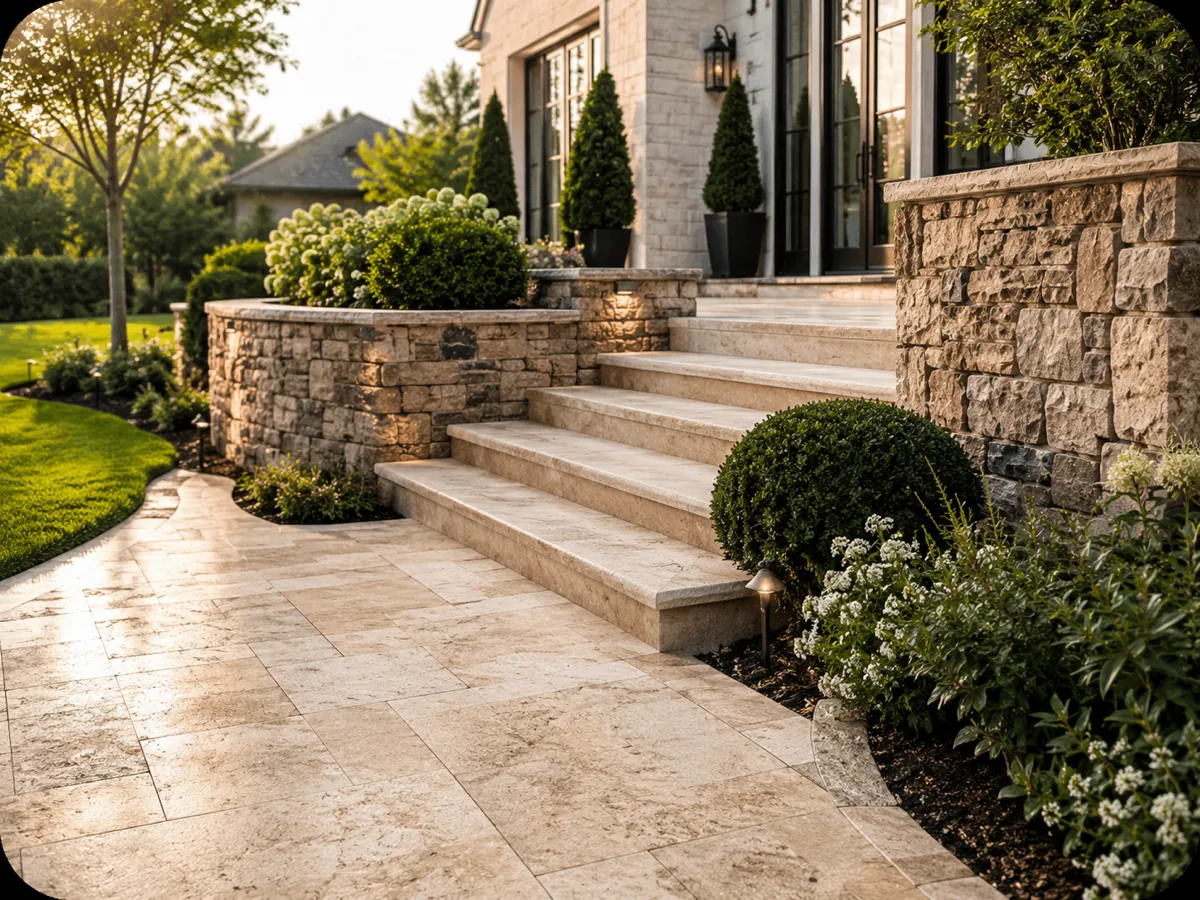
- Florida tumbled travertine pool decks & patios
- Marble and natural stone outdoor walkways
- Mortar-set installation on proper base
- Grouting and sealing for weather & pool-chemical resistance
- Cutting and fitting around pools, curves and existing structures
- Replacement and repair of existing stone surfaces
- Slippery, hot or deteriorating pool deck surface
- Cracked or sunken pavers around the pool
- Outdoor surface that can't handle heat, pool water and foot traffic
- Want a natural stone look without the maintenance of unsealed material
Four steps from the first visit to the finished work.
- 01
Consult
We visit your property, listen to how you want to use the space and take measurements.
- 02
Design
You get a clear plan and a written quote covering materials, layout, drainage, timing and price.
- 03
Build
Our in-house crew prepares the site, installs hardscape and softscape, and cleans up daily.
- 04
Maintain
If you want, we come back each season for aeration, fresh mulch and irrigation tuning to keep it looking new.
Travertine pricing, and where it earns the premium
Travertine installed runs roughly $22 to $38 per square foot, against $14 to $24 for concrete pavers. A 500-square-foot pool deck therefore lands somewhere between $11,000 and $19,000. That is a real gap, and it is only worth paying in the places where travertine does something a paver cannot.
The clearest of those is heat. Travertine stays markedly cooler underfoot than concrete or dark pavers in direct August sun. Around a pool, that is the difference between a deck people stand on barefoot and one they hop across. It is also naturally slip-resistant when wet, which is the second reason it dominates pool surrounds.
- French pattern. Four repeating sizes in a woven layout. The classic look, and the most forgiving of a slightly irregular space.
- Large format. Fewer joints, calmer surface, higher cost per square foot and less tolerance for an imperfect base.
- Bullnose coping. The rounded edge around a pool or a step. Priced per linear foot and always worth doing properly, because it is the piece people touch.
Sand-set or mortar-set, and why that choice matters here
Travertine can be laid on a compacted aggregate base with a sand setting bed, the same way pavers are, or mortared onto a concrete slab. On our clay we usually recommend sand-set for new work: the surface can move with the seasons instead of fighting them, and an individual piece can be lifted years later. Mortar-set is right when there is already a sound slab worth keeping.
Either way the base does the work. Excavation, geotextile over the subgrade, compacted aggregate in lifts, a screeded bedding course, edge restraint on every open edge, and a pitch of about a quarter inch per foot away from the house and away from the pool. Travertine is more brittle than concrete paver, so an inadequately compacted base breaks pieces instead of just settling.
Cuts are made wet to control dust and to avoid chipping the face. Around a pool, coping is set first and the field is cut to it, never the other way around.
Sealing, winter and the honest downsides
Travertine is limestone, which means it is porous and it reacts to acid. Seal it after installation and roughly every two to three years after that, with a breathable penetrating sealer rather than a film-forming topcoat that will cloud and peel. Spilled wine, citrus and some acidic pool chemicals will etch an unsealed surface, and etching is a dulled spot rather than a stain, so it does not wash out.
Winter is the other honest caveat. Water sitting in the natural pits of the stone can freeze and spall the surface, so drainage and sealing matter more here than they would in Florida, where most travertine marketing photos are taken. Keep de-icing salt off it entirely; use sand.
None of that makes it a bad choice around a pool in Iredell County. It makes it a choice that needs to be installed and sealed correctly, and told to you straight before you buy it rather than discovered in year three.
Ready for a natural stone surface that lasts? Let's walk your property.
We'll walk the property, ask how you want to use it, and follow up with a written quote that lays out scope, materials and price. We won't push extras you didn't ask for.
Get Your Free Travertine & Natural Stone Estimate
Tell us about your project and a local LAP Landscaping crew member replies quickly with a clear plan and an honest price, with no pressure and no obligation.
Form not loading? Call 704-327-5663.